One day, someone thought to ask, "Gee, Lion, what happened while you were away?" The lion thought for a moment and then he replied:

No society that loved its children would divorce them so completely from contact with soils, forests, streams, and wildlife. No society that loved its children would create places like the typical suburb or shopping mall. No society that loved its children would casually destroy real neighborhoods and communities in order to build even more highways... No society that loved its children would build more shopping malls than high schools. No society that loved its children would leave behind a legacy of ugliness...
Loving Children: A Design Problem by David Orr
via Stork Bites Man


"The best part of my job is getting to work with a lot of amazing people..."
— Oscar Tuazon (This Long Century)
Previously: Coming Soon

Join KARMA at ICA for a two-day pop-up shop and a special presentation at 4pm on Saturday, Nov. 12. Part of the Excursus I series of events.
Institute of Contemporary Art
118 S. 36th St., Philadelphia, PA
icaphila.org/excursus
The study of architecture is marvelous training for anything but architecture.
— Saul Steinberg
"I invite each of you to sit down in front of your television set when your station goes on the air and stay there, for a day, without a book, without a magazine, without a newspaper, without a profit and loss sheet or a rating book to distract you. Keep your eyes glued to that set until the station signs off. I can assure you that what you will observe is a vast wasteland."
Change the Channel: WCVB-TV 1972–1982
curated by Gary Fogelson and Michael Hutcherson
January 12–March 5, 2011
apexart, 291 Church Street, New York, NY
Opening reception:
Wednesday, Jan. 12, 6-8 pm
...
Seeing the work that is to be done, who can help wanting to be the one to do it?
But one is afraid that there will be no rest until the work is finished and the house is in order, the farm is in order, the town is in order, all the loved ones are well.
But it is pride that lies awake in the night with its desire and its grief.
To work at this alone is to fail. There is no help for it. Loneliness is its failure.
It is despair that sees the work failing in one's own failure.
This despair is the awkwardest pride of all.
—Wendell Berry, "Healing" from What are People For?
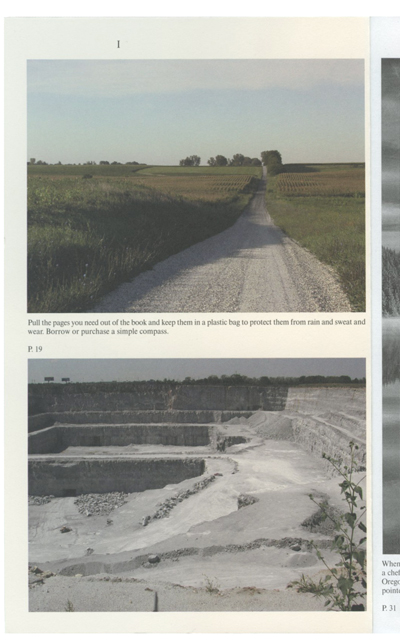
The pilgrimage unfolds in three simple parts, like a song: verse, chorus, verse. In the first verse you mostly listen to research, training, the blessings of supporters. Then, of course, you walk. And finally the second verse, when you sing. You report back to your supporters and friends—which might now include people met along the way—about your experiences, the people and places you witnessed, and what is happening to you.
Read: "Three Part Path: A Brief Guide to Making a Pilgrimage for the Purpose of Reforming Your Relationship to the Landscape" which has been re-printed in Issue 9 or the Journal of Radical Shimming (above).
If a factory began to "grow" or to be noisy at night or on Sunday, that would mean that another such factory was needed somewhere else. If waste should occur at any point, that would indicate the need for an enterprise of some other sort. If poison or pollution resulted from any enterprise, that would be understood as an indication that something was absolutely wrong, and a correction would be made. Small scale, of course, makes such changes and corrections more thinkable and more possible than does large scale.
From An Argument for Diversity by Wendell Berry (1988)


